08 January 2022

Depa juai dan suruh kita menangis...


MACC – 'Mana ada corruption case'...

The old joke goes that MACC stands for “mana ada corruption case” when it comes to certain VVIPs. Now, it may have hit right back home when the very chief of MACC himself, Azam Baki, was shown to own almost two million company shares.

Was his civil servant salary enough to pay for it all? Or did he follow the “glorious” example of the Birkin bag lady, who claimed that she “menabung dari kecil” (saved up from young) to buy her luxury handbags, jewellery and watches?

No, instead the explanation given by the MACC Advisory Board (LPPR in Malay) was that the household dog, I mean cat, had eaten up the homework – namely that his account had been used by his brother to buy the shares.

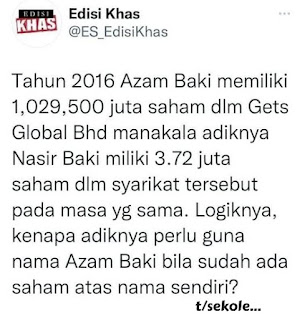
Well, well, are we to believe that Azam has a very rich brother? Who did not even have his own share trading account? And was willing to risk 10 years in jail to “borrow” Azam’s account?


National comedy

Azam-gate can seem like our national comedy show being repeated. When the world was talking about Malaysian kleptocracy, there was NFA or “no further action” by MACC.

Back in Aug 2015, MACC had “found out” who “donated” RM2.6 billion into former prime minister Najib Razak's personal bank account but whoops, could not reveal the identity of this mysterious Middle-Eastern fellow.  So, of course, this led to more jokes that the mystery donor was none other than the royal “Arab” called His Excellency Al-Sheikh Prince Jho Low bin Penang!

Similarly, where was the MACC when Zahid Hamidi, the Home Minister before the last elections, was allegedly siphoning off RM31 million from the Yayasan Akalbudi “charity foundation” to pay off his personal credit card bills rather than helping the poor?

The comedy part of all this comes from the defences used. In his corruption trial, Najib Razak insisted that the millions that flowed into his personal bank account from SRC International were from “Arab donors”. This, said the Court of Appeal, was a tale which “surpassed even those from the Arabian Nights” (you know, all those Aladdin flying carpet stories and whatnots).

As for Zahid, he claimed that his officer had “mistakenly used funds from the Yayasan Akal Budi” charity to clear his credit card debts. Wow, can I get such an officer to “mistakenly” buy me a Mercedes too?


Casual corruption

What these cases reveal is that our VVIPs don’t even bother covering their tracks. For example, Najib was convicted based on a clear trail of documents that led straight to him. I mean, come on lah, even if you want to do something like this, at least take the trouble to route the money through a complex web of hidden nominees and offshore Cayman Islands accounts or whatever.

The fact that Najib and Zahid did their dubious dealings in plain sight means they believed the system would never punish them for their misdeeds. And their laughable excuses suggest that they don’t care how bad it all looks. In other words, corruption has become almost casual.

Now, we have the “cat ate the homework” excuse by LPPR. Apart from being funny, it’s also sloppy. It claims that Azam had completely transferred the two million shares to his brother by 2015, yet evidence shows that he still owned half of it in 2016.

This reminds me of how Anwar Ibrahim was charged for committing sodomy with his driver at the Tivoli Villas condos on a certain date when the darn place had not even been built! This led to an amendment of the court charges, which raised suspicion if the whole drama (complete with a mattress in court) had been cooked up.

When we put everything together – doing misdeeds in plain sight, laughable excuses and sloppiness in details – the public may ask: do these people somehow know that various watchdogs have been trained (with goodies?) to close one eye? This is the deadly serious implication of Azam-gate. Yes, a man is innocent until proven guilty, and so a proper investigation is needed. But who will do it?

If a teacher is accused of molesting a student, is it enough for the headmaster to declare that he had looked into the case and “all is settled”? Similarly, if the IGP himself is accused of something like taking bribes from gambling syndicates, can some police board declare that “oh it was all a misunderstanding lah”? Can a school investigate itself? Can the police investigate itself? Can an MACC body (such as the LPPR) clear the MACC chief?

So please forgive the public if they don’t entirely believe the clumsy “my brother did it” reason given by the LPPR. Sadly, trust in our institutions has been ever more eroded in the past 30 years, and Azam-gate is the latest blow. The VK Lingam “correct, correct, correct” scandal struck the core issue of judges’ independence, and that’s why a Royal Commission of Inquiry (RCI) was set up to probe the matter.

Azam-gate strikes at the heart of national integrity, so perhaps only an RCI will have the weight, standing and public confidence to handle this matter. However, LPPR chairperson Abu Zahar Ujang said, "Currently, there is no need…” for an RCI.


The scandal playbook

So what happens now? If we were rehashing the old playbook, somebody might soon announce that all this is “politically motivated”. For example, this is what Zahid’s supporters tried to claim for his corruption case. 

Perhaps some politician trying to score popularity points will accuse professor Edmund Terence Gomez (the man who revealed Azam-gate) of being a non-Muslim trying to cause “disharmony” and “confusion” among the great brotherhood? The academic group Gerak has pointed out that some cybertroopers have already twisted this into a racial issue. 

Meanwhile, the most “holy” party in the government will probably remain studiously silent on this crucial issue and choose instead to play up small sideshows similar to Timah whiskey. Yet such “patriotic” folks should remember how Zahid and his wife “defended” race and religion – by allegedly using over RM1.3 million in “charity” funds to pay for shopping at luxury stores like Giorgio Armani, Louis Vuitton and Hermes.  Ah yes, maybe these French brands are now part of the “perjuangan” too?

If all that doesn’t work, perhaps some politician will launch a new controversy (hey, how about Jawi-khat part two?) to divert attention away from Azam-gate. Or some toothless “committee” will be set up (to “look into” the issue) as a delaying tactic until everything is forgotten.

So how will Azam-gate be resolved? The man in the centre of the storm claimed that he is “answerable only to” LPPR. This is clearly wrong (morally, if not legally). 

As the public guardian against corruption, MACC is answerable to all Malaysians. As the Malay proverb goes – Harapkan pagar, pagar makan padi. In other words, the MACC is the pagar or fence that guards the padi fields against thieves that will eat up society.

So when VVIPs are suspected of stealing public money, MACC cannot just shrug and say: “Mana ada corruption case.” Unless the fence itself has started nibbling at the padi? - Andrew Sia,mk

Azam Baki should have told his 
brother to"f**k off" - Robert Phang

A former Malaysian Anti-Corruption Commission (MACC) advisory board member has grilled the graftbusters’ chief commissioner Tan Sri Azam Baki, asserting that he is making a mockery out of the people and the country’s judiciary system by looking to clear himself of any alleged wrongdoings.

Tan Sri Robert Phang (pix,above) now a prominent social activist and philanthropist, said Azam further convoluted the matter by implicating Anti-Corruption Advisory Board (LPPR) chairman Tan Sri Abu Zahar Ujang as the one who absolved him of any wrongdoing, suggesting LPPR as infallible.

He added that Azam breached MACC standard operating procedures (SOPs) by allowing his brother to use his share-trading account, saying such actions were equivalent to condoning an offence.

“101% he breached the rules. It concerns SOPs, because if my brother approached me (to use my trading account) and I was an MACC chief, I would tell him to f*** off.

“But now you allow him to carry on, so that’s the same as condoning an offence that amounts to the same punishment – in my view.

“He (Azam) is making a fool out of us, the system, and the entire judiciary. Letting him go is the easy way to go about it, but this case should be investigated by police or any other independent body, without fear or favour. “Because we are watching, the rakyat is watching, the whole world is watching,” Phang told The Vibes.

This is in response to Azam and Abu Zahar’s remarks, where the latter during a press conference yesterday insisted the MACC chief did no wrong in allowing his brother to use his share-trading account.


Phang today suggested to The Vibes that a royal commission of inquiry (RCI) into the matter would be the most suitable option to get to the bottom of it.

“A proper RCI should be formed to probe into the whole thing because the MACC chief himself has been implicated, so where is the faith, trust, and confidence that we are supposed to have in MACC? “The system has been screwed up by this stupidity, oh Azam.”

Phang added that LPPR should consider applying for a temporary interdiction of Azam’s tenure while investigations are underway to avoid any further conflict of interest. An interdiction refers to an official instruction from a court of law barring someone from a certain action.

“I would recommend for the board to interdict him with half pay, because when you say no pay, that could look like someone is convicted already, but when it's half pay, there is still a chance (to be absolved) and society will still think that you are not guilty until proven.”

In yesterday’s press conference, Abu Zahar said LPPR conducted a meeting with Azam on November 24 to seek an explanation on the allegations that have since plagued the anti-graft body. He added that LPPR was satisfied by the explanation given by Azam and found no criminal elements involving him or conflict of interest.

Azam meanwhile insisted he as the chief commissioner is only answerable to LPPR. He also claimed the allegations of conflict of interest brought against him were created by certain parties looking to take advantage and attack MACC and ruin the commission’s image and his personal reputation. – Emmanuel S.M. Chin,The Vibes

cheers.

07 January 2022

Bos SPRM terperangkap dalam gamenya sendiri...


Securities Commission to 
'be in touch' with MACC chief...

The Securities Commission (SC) said it will be speaking to MACC chief Azam Baki after he admitted that his brother had used his name to purchase shares.

"The SC will be in touch with the parties involved, including Tan Sri Azam Baki, for an explanation and to verify statements made, as well as gather any relevant evidence," it said in a statement.

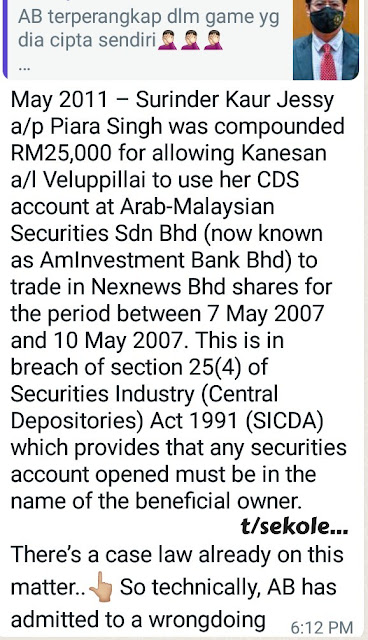
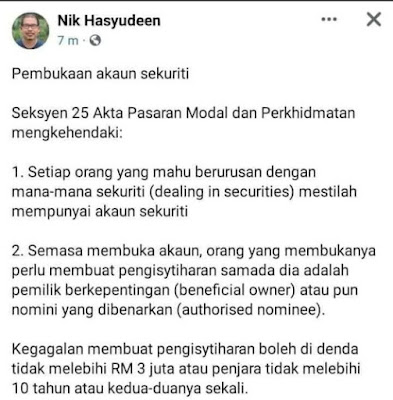
The SC pointed out that under Section 25 of the Securities Industry (Central Depositories) Act 1991(Sicda), every security account opened with a central depository must be in the name of the beneficial owner of the deposited securities or in the name of an authorised nominee.

"In addition, section 29A of SICDA stipulates that all dealings in securities shall be effected only by the beneficial owner of the securities or an authorised nominee," it added in a statement. Offences under Section 25 is punishable with a fine of up to RM3 million or imprisonment of up to 10 years or both.


Azam had faced pressure to explain his ownership of millions of shares in two public-listed companies in 2015 and 2016. MACC's Anti-Corruption Advisory Board chairperson Abu Zahar Ujang convened a special press conference yesterday to explain the issue.

Abu Zahar said the shares were purchased in Azam's name by his younger brother and declared he had done nothing wrong. He added that Azam had since transferred the shares to the brother. However, the press conference opened a can of worms, with the opposition accusing Abu Zahar of acting beyond his authority.

Kepong MP Lim Lip Eng had said the admission could constitute a possible violation of Sicda. Sungai Buloh MP R Sivarasa previously also pointed out that Section 23 of Service Circular 3/2002 forbids a civil servant from owning more than RM100,000 in shares. - mk

SC Calls Azam and He Sues Lalitha...

1. As the Securities Commission (SC) announced that it would call up Azam Baki over his 2015 stock market dealing, the later announced that he was initiating a libel suit against one of his accusers. 

2. The SC said it wanted the Malaysian Anti-Corruption Commission (MACC) Chief Commissioner to verify the statements made as well as to gather any relevant evidence. 

3. It said, under Section 25 of the Securities Industry (Central Depositories) Act 1991(SICDA), every securities account opened with a central depository must be in the name of the beneficial owner of the deposited securities or in the name of an authorised nominee. 


4. In addition, it said, Section 29A of SICDA stipulates that all dealings in securities shall be effected only by the beneficial owner of the securities or an authorised nominee. 

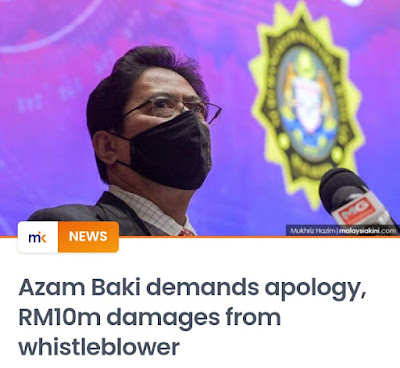
5. Azam, on his part, said he had initiated legal proceedings against Lalitha Kunaratnam, senior researcher at the Centre to Combat Corruption and Cronyism (C4) for defamation. 

6. He said, this was done to protect his good standing and professional reputation, and went on to warn that he would not hesitate to commence legal proceedings against anyone else who spreads or makes similar "false and malicious" allegations against him or members of his family.
 
7. Meanwhile more legislaters are demanding that the issue be debated in Parliament. - A.Kadir Jasin

Why should we dip into Retirement Funds 
every time the incompetent Govt screws up?...

We had warned back in 2020 the consequences of dipping into KWSP / EPF retirement funds during the Covid-19 pandemic. Its contributors should reject any proposal to use their own retirement funds – prematurely. However, as many as 7 million members had chosen to withdraw their own savings from various schemes introduced by the backdoor Muhyiddin government.
 
Basically, there were two types of members who had decided to take advantage of the schemes, from “i-Lestari, i-Sinar to i-Citra”. The first type was desperate contributors who had lost their source of income. The second type was members who did not trust the backdoor government, hence they withdrew their hard-earned money and reinvested them elsewhere.

Regardless, they should not withdraw because the fund was meant for their own retirement age. Instead, the Employees Provident Fund contributors should force the government to fix the problems. This may sound unpatriotic, but it’s better for the government to borrow – even sell national assets – to help the people during the crisis, rather than emptying their retirement coffers.

Even if you don’t like the idea, the clueless and corrupt government will still sell national assets to enrich themselves anyway, as in the case of Najib’s 1MDB scandal. Besides, it was the power-crazy Muhyiddin who mishandled Covid pandemic and mismanaged the economy, leading to unemployment, underemployment, sagging economy, fleeing investors and whatnot.
 
Now, the same selfish leaders, especially former PM Najib Razak and UMNO president Zahid Hamidi, are again aggressively promoting the withdrawals from EPF for flood victims. Can you see how the government, whenever it screws up, has made it a habit of telling the people to dip into their own savings to save themselves? First, it was the Coronavirus and now the floods.

Hilariously, Finance Minister Tengku Zafrul Aziz, who had taken pride in allowing EPF withdrawals during the Covid pandemic, has now fiercely rejected any further withdrawals. He even called people like Najib and Zahid “provocateurs”. Zafrul suddenly could argue intelligently that new withdrawals would burden the next generation who would have to care for the elderly with no retirement savings.

Ex-Prime Minister Najib Razak

Mr Najib, the biggest national crook who had diverted part of RM4 billion loans from KWAP (Retirement Fund Inc) to his own personal bank accounts, has given three funny reasons why EPF withdrawals should be approved. First, he said the withdrawals will help kick-start the economy. He said another “one final” withdrawal – ranging from RM5,000 to RM10,000 – should be allowed.

Assuming 100,000 flash victims are allowed to withdraw the maximum RM10,000, it would translate to RM1 billion. If a total of RM101 billion withdrawn from the previous three schemes had failed to kickstart the economy, what makes Najib so cocksure that RM1 billion could? Has he forgotten how the country plunged into technical recession after the economy contracted in second and third quarters 2021?

Najib said the withdrawals can be managed by increasing the contribution from employers. He basically wanted to manipulate the system by forcing employers to pay more to fix a problem created by the lazy and clueless government. He also suggested a restructuring of dividend rates by giving more projects to EPF, such as UK-based Battersea Power Station project.

Perhaps Najib has also forgotten how EPF, along with Permodalan Nasional Bhd (PNB), was forced to cough a whopping RM8.3 billion to bail out Battersea due to financial strain and cost overruns. The retirement funds’ role is to invest, not to manage a project that it does not have any expertise, and certainly not to bail out another mega project after a bad business decision had been made.

Thanks to Zafrul, Najib and former PM Muhyiddin leadership, 6.1 million members – nearly half of EPF contributors – are being left with less than RM10,000 in their accounts. And of that number, 3.6 million members have less than RM1,000 (US$238) in their retirement funds. Yet, Najib has the cheek to argue that members should be allowed to withdraw more.

The crook has obviously lost touch with the ground when he said employees would work even harder to recover their savings if they are allowed to withdraw. If they have to dip into their retirement coffers because they don’t even have RM5,000 or RM10,000 in banks, chances are they would not be able to replenish their EPF even if they work doubly hard simply because they are low income workers.

EPF/KWSP Retirement Savings...

Like it or not, the poor financial position of EPF members today is the direct results of decades of structural problem due to bad policies. Even before the pandemic, more than two-thirds (68%) of EPF members aged 54 had less than RM50,000 in EPF savings (based on a study in 2017), a far cry from the minimum savings target of RM240,000 in their account by 55 in order to enjoy a decent retirement.

To attract foreign direct investment (FDI), Malaysia has adopted policies of cheap labour and generous government incentives since 1980s. From plantations to electronic factories, the country employed low-skilled labour where value-added is low and there is little productivity growth. Initially, it worked wonderfully as it shifted to the industrial sector from an agricultural economy.

In fact, Malaysia had managed to maintain high growth rates over two decades. Its annual growth rate was close to 10% – till the arrival of 1997-1998 Asian Financial Crisis. From 2002-2008, the economic growth rate was averaging 6%. It has never been able to go back to its former glory. The service and manufacturing sectors continued its dependence on cheap labours.

Even though a public sector agency – HICOM (Heavy Industries Corporation of Malaysia) – was established in 1981 to lead the heavy industrialization programme, the wrong policy of protection through tariff in sectors such as motor vehicle assembly and cement industries means the country did not learn to compete in an open market. It creates the culture of complacency.

Corruption, mismanagement and inefficiency saw the industries suffered severe financial losses due to lower-than-projected domestic demand and high operating costs. That was why then-PM Mahathir shocked the nation in the 1980s, when he unleashed another half-baked policy – 70 million population – to create a self-sustaining market.

For example, Perwaja Steel, a US$465 million joint venture established in 1982 between HICOM and Nippon Steel Corporation was supposed to be the centerpiece of industrialization. However, it was plagued with mismanagement, production woes and a mountain of debt instead, so much so the Mahathir administration said it would swallow Perwaja’s RM9.9 billion in losses.

Proton Saga...

Proton (Perusahaan Otomobil Nasional), another industrial project, dominated the domestic market because it was protected by an average 200% tariff on imports of foreign-built cars. Yet, despite “Look East” policy, Proton’s technology partner Mitsubishi was merely using Proton to manufacture and market its own models in Malaysia, without any technology transfer at all to Malaysia.

To make matters worse, the racist and discrimination policy like NEP (New Economic Policy), which was derived from “Ketuanan Melayu”, the ideology of Malay supremacy espoused by UMNO (United Malays National Organization), saw brain drain in the form of hundreds of thousands of technical skills went through a large scale migration to other countries.

The NEP has even failed to achieve its main goal of income distribution primarily due to cronyism and nepotism. Millions of Malays remain poor while a handful of billionaire cronies like AP King Nasimuddin, Syed Mokhtar Al-Bukhary, Halim Saad, Wan Azmi, Amin Shah, Tajuddin Ramli, Vincent Tan, Ting Pek Khiing, Yeoh Tiong Lay, Ananda Krishnan and even Mahathir’s own sons Mirzan and Mokhzani were created.

Adding fuel to fire, the race and religion politics saw national schools becoming religion schools, producing increasingly low standard students, who, despite tertiary education in local universities, were unemployable as they can’t even communicate in simple English. Most would gain employment with the civil service, unable to compete in the highly competitive private sector.

However, even in the private sector, Ministry of Human Resources through the National Employment Studies in 2009 found that 33.8% of private sector workers were paid below RM700 per month. The World Bank actually found that wages in Malaysia only increased 2.6% yearly. It was only in 2012 that the government announced minimum wages of RM900 (for Peninsula Malaysia) and RM800 (for Sabah and Sarawak).

In July 2020, after much pressure and criticism, Malaysia reluctantly revised the national poverty line income from RM980 to RM2,208 – plunging more than 400,000 households into “poor” category. Still, it doesn’t make sense that the minimum wage remains at RM1,100-RM1,200 when the new poverty line rises to RM2,208. What do you call those who earn RM1,200?

Malaysian Ringgit Toast - Seller Counting Money

Real wages have been low or stagnating because of price controls, subsidies and the influx of cheap unskilled foreign workers. This is because the government deliberately wanted to artificially create cheap labour in order to attract both foreign and domestic investments. The real problems happened when Malaysia suddenly had to compete with China or Vietnam, who possessed cheaper labours.

Interestingly, back in 1969, both South Korea and Malaysia were classified as lower-middle income countries. Yet, by 1988, South Korea attained upper-middle income status and subsequently high-income status by 1995. Its gross domestic product (GDP) per capita rose tremendously in four decades – from US$1,715 (1980) to US$31,762 (2019) – due to heavy investment in technology, education and R&D spending.

Malaysia, on the other hand, remains “trapped” as an upper-middle income country since 1996. Its GDP per capita over the same 40 years has increased from US$1,775 (1980) to US$11,415 (2019) only. The country is in desperate need of not only foreign investments, but also to create unicorn companies in high-tech sector like Grab or Lazada.

However, the country has a peculiar habit of chasing away top brains – either talents or companies – if the skin colour does not match the government specification. It didn’t help that Malaysia is the world’s second most expensive country to buy cars, after Singapore. A large portion of take home salary would be spent on servicing the car loans, which could stretch to 9 years.

Malaysia’s reliance on cheap labour as the country’s main competitive edge for foreign and domestic investors had caused a lag in raising wages, which contributed to little savings and small monthly contribution to EPF retirement funds. The structural issue spirals out of control when one factors in unaffordable housing, elevated household debt, crazy car prices, and weak Ringgit.

Therefore, flood victims should not burn their own retirement savings to make ends meet. The government should be made to dip into “windfall tax” announced during the 2022 Budget to aid the victims. Even if RM10,000 is given to 100,000 people, it would only cost the government RM1 billion – a clear cut solution. - FT

cheers.

06 January 2022

Binatang pun pandai pertahankan hak mereka...


As Melaka braces for the second wave, Aras, a small boy from a fishing village in Teluk Berembang held my hand, eager to show me what’s left of his house ravaged by floods. He now lives with grandpa Yusof after having lost his parent recently. - MelGoh,CNA

Lessons from the floods...

The floods that inundated many parts of Selangor, the Federal Territory of Kuala Lumpur and Pahang two weeks ago were reminiscent of what happened in New Orleans, Louisiana in August 2005. The devastation caused by Hurricane Katrina illustrated the mismanagement and lack of preparation in the relief effort on the part of the government.

Thousands of people were trapped in their homes and stranded on rooftops, while those placed in shelters were left without food, water and proper sanitation. More than 1,800 people perished and the economic cost ran into billions of dollars.

The condemnation came fast. The New Orleans mayor at the time, Ray Nagin, was lambasted for inaction. President Bush Jr, who initially praised the Federal Emergency Management Agency (Fema), had to live with his mistake. Fema was asleep while 80% of New Orleans was submerged in water.

Fast forward 16 years and our National Disaster Management Agency (Nadma) is vilified for the same reason. Images of people caught in traffic jams, stranded fearfully in their homes and on the rooftops of mosques and buildings, captured on social media shocked the nation. The heavy rain since Friday (Dec 17) was a warning that things will get from bad to worse.

Taman Sri Muda, Shah Alam flood of 1995 and 2021. It looked liked it has 
became more severe and serious. Who is responsible? Federal or state govts?
 
Yet even as many parts of the Klang Valley were experiencing the heaviest rainfall in recent memory, the authorities were hesitant to react to the call for help. There was no command and control. Or anyone to authorise the utilisation of critical assets to help the victims. It is the people who rose to the occasion. Social media became a powerful tool to galvanise people’s movement to help the needy.

There are simply too many stories of goodness and kindness. While many have given up on fellow Malaysians to be kind and to understand each other – largely because of bigotry and political divisions – people from all walks of life, regardless of race and religion, were helping each other in times of adversity. The true colours of humanity emerge in trying times. For Malaysia, it was during the misfortune caused by the flood.

I visited the Gurdwara Sahib in Petaling Jaya on Dec 26. It was a scene that was both gratifying and humbling. Volunteers from all races were there to help. The place was bustling with activity. Contributions came in and were later distributed with military precision. There are many such centres sprouting all over the country by religious groups, NGOs and individuals to give a helping hand. People came from all over bringing food and basic amenities to alleviate the pain of those affected.

Suddenly volunteerism is taking a new form. The young, especially, reacted in the most commendable way. As the true horror of the flood surfaced in the morning of Dec 18, volunteers were already in full gear preparing food, trying to save the stranded and readying them for temporary shelters. All these actions took place while the government was still unsure of what to do. Sadly, for many, Nadma, like Fema in 2005, did not react the way they should have. Like Fema in 2005, it failed spectacularly.

Kepala air yang potong balak...

While it is true no one expected such floods to happen in Selangor and the Federal Territory of Kuala Lumpur, every sensible person knows floods are inevitable these days. In the east coast, the monsoon will bring mayhem normally in December and January. Yet, in 2014, we failed to prepare adequately. Kelantan experienced one of the worst floodings. But the lingering image at the time was our then prime minister playing golf with President Barack Obama in Hawaii.

Things are no better this time. Political leaders are quick to point fingers at each other. Some are conspicuously absent, a few are busy printing their pictures on aid packages while those who wanted to endear themselves to the public became the target of people’s ire for their insensitivity and even stupidity. But then, there are many Members of Parliament and state representatives who served the people admirably without the glare of publicity.

It is foolish of us not to accept the fact that climate change is real. We are largely to be blamed. Moral of the story: we must take care of the environment and protect it. We have made mistakes in the past. There are housing areas and developments that shouldn’t have been approved in the first place. We have little regard for our rivers. We desecrate our jungles.


Even Zainal Abidin, the singer known for his signature song Hijau, was not spared this time. His house was among thousands affected by the floods. The lyrics of the song were about the death of the environment. Had only we listened carefully to the lyrics of Hijau or at least part of it, perhaps things would have been different:

Dewasa ini kita saling merayakan

Kejayaan yang akhirnya membinasakan

(For now we gather to celebrate,

The success which finally destroys us)

Spot on, Zainal! - Johan Jaaffar,the Star

No family ties...

Anwar Ibrahim does not need nepotistic ties to remain relevant. Mukhriz Mahathir, who could not even complete the two full terms as the former menteri besar of Kedah, is hardly in a position to make disparaging comments about PKR president Anwar Ibrahim.

While ultimately Malaysians will judge as to the suitability of Anwar as the next prime minister, it is not for Mukhriz to say that Anwar is not appropriate for the post of the prime minister of the country.

Anwar would have been the prime minister a long time ago when he was deputy to Mukhriz's father, former prime minister Dr Mahathir Mohammed. It was Mahathir who spoiled his chances by imprisoning him for some trumped-up charges.

Much later, Anwar was Pakatan Harapan’s natural choice of prime minister after it won national power in 2018, but unfortunately, Anwar was in prison. Mahathir was made the interim prime minister until such time that Anwar was pardoned to return to active politics.

Mahathir should have made way for Anwar to succeed him. But this was not what happened. In fact, Mahathir hijacked the post, refusing to give it up to Anwar.

Whose fault was this, is Anwar to be blamed for this? Or the Harapan leadership?

Was it Anwar’s fault that the infamous “Sheraton Move” resulted in the backdoor government of Muhyiddin Yassin, the former prime minister, the architect of the arrest and detention of those who were allegedly linked to the defunct LTTE.

Why did Mahathir refuse to abide by the agreement with the Harapan coalition in vacating the prime minister’s post to Anwar? Did Mahathir create the preconditions for the ouster of the Harapan government?


Whatever Mukhriz (above) might say about Anwar, the fact remains that he would have been the prime minister if his father had honoured the agreement with the Harapan coalition. It was Mahathir, only Mahathir, who betrayed the promise in handing over the post to Anwar.

Maybe Mukhriz would want to examine and digest a bit of history before joining others in saying that Anwar might not be appropriate as the prime minister. Is he suggesting that his father should be given another chance at the post?

Anwar would have been the prime minister had Mahathir kept his word. Mukhriz is the last person who should be talking about whether or not Anwar is a suitable person to become the prime minister.

I am not sure whether he is deluded into thinking that somebody else might stand a chance to become the prime minister for the third time.

Anwar might have lost his opportunity in the past, but he still stands a chance to become the prime minister in the future, provided Harapan gains political ascendancy in the next general elections. It is not going to be easy, but then politics is the art of the possible.

There might be calls for the resignation of Anwar and other Harapan leaders from some quarters, something to be expected. Without Anwar the opposition could not have arisen to the present level and strength.

Anwar might have his detractors, but he, unlike Mukhriz, does not need nepotistic ties to be relevant in Malaysian politics.

PKR has over 30 members of parliament, but Pejuang has four. In comparison with PKR, Pejuang is a mosquito party. In a tropical country like Malaysia, mosquito bites are common. In this respect, Mukhriz's diatribe is another mosquito bite against Anwar. - P.Ramasamy

cheers.

04 January 2022

Balak terjun dari kayangan...


MP appeals to Agong to act against 
those who misuse his name for logging...

Shah Alam MP Khalid Abdul Samad has appealed to the Yang di-Pertuan Agong to act against those who misused his name for logging activities.

This came after a video was circulated on social media showing a verbal confrontation where a "Datin" accused a man of damaging the environment but the man rebutted her by stating that he was from the Pahang royalty and will be "meeting with Tuanku".

"The man appeared to claim he had the protection of the palace and people with the title of 'Tan Sri' or 'Datuk Seri' are small and there was nothing to be worried about because he was with the palace.

"I am confident that Tuanku Yang di-Pertuan Agong is not involved and his name and that of the Pahang palace were being misused.

"His Majesty's name is being sullied by those who are irresponsible," Khalid (above) said in a statement. Yang di-Pertuan Agong Sultan Abdullah Sultan Ahmad Shah is also the Pahang sultan.


Kepala air punya workmanship...

Khalid appealed to the ruler to clarify the situation and distance his majesty from those who are misusing his good name. The lawmaker said he was confident that the ruler cared about the people's suffering.

Logging activities have been under the spotlight after parts of the country suffered flash floods due to sustained rain.

The situation in Pahang has raised eyebrows as flooding there had brought with it a large number of logs, raising concerns over whether logging was partially responsible for the disaster.

The Pahang Forestry Department claimed the washed logs were from landslides. However, environmental groups have highlighted that some of the logs were sawed-off. - mk

Abandoned school, a 'Pontianak' 
and accountability...

Twenty-two years ago, I moved to Taman Desa, Kuala Lumpur, with my family. We rented an apartment overseeing a large piece of land that looked like a common wetland area.

Every weekend, I saw people walking in and out of the area – with fishing rods and their catch of the day. On a clear day, white storks would be flying around looking for snacks. Having a peaceful looking green area right across the street from my balcony was a delight I must say, especially after a long stressful day.

A couple of years later, a new construction project to build a public school took place in the area. Many of us in the neighbourhood discussed the suitability of the soil structure of the land for a school building, especially since it involved the safety of children.

However, since construction projects would normally include regular progress reports submitted to and approved by the client – which in this case is the Education Ministry - we believed everything would be well executed.

In 2003, SK Danau Perdana was built at the cost of RM14.5 million. Situated at Jalan 1/109F in Taman Danau Desa, Jalan Kelang Lama, the school started to enrol its first batch of students that year.

My daughter, who started her schooling in 2004, was among the school’s second batch of students. During her schooling days in Primary One that year, many of the parents, including myself, observed cracks on the walls of the school (photos, above). When we informed the school management, we were asked to calm down and given the assurance that the premises were new and safe.


And then, a flying roof

A few months into 2004, more cracks appeared on the indoor and outdoor walls of the building, so much so that it became a common sight around the school. Reports were then made and certain areas, including a few classrooms and corridors, became no-entry zones.

To look into the matter, the school was visited by a few government officials, including a minister. This visit resulted in barricade tapes being plastered to block off the danger areas.

However, the school was still operational. Children whose classes were located in the danger areas were relocated to different floors.

And then the monsoon season began. During a heavy downpour, a chunk of the roof came crashing down. Although no students, teachers or workers were injured, the incident made quite a number of parents fearful of the disaster waiting to happen – including me.

Eight months after enrolling my daughter in the school, I transferred her out. I was not going to risk her safety in such a place. About two months later, part of the school’s wall collapsed and the building began to sink. The school was finally deemed unsafe. By the end of 2004, the school was ordered to be shut down.


Emptied and abandoned

With the school emptied and left abandoned, protective fences displaying warnings were set up to keep people away. However, it failed to stop drug addicts and vagrants from turning the building into becoming their hangout spot. Soon, the walls were painted with graffiti, classrooms filled with trash and recyclable materials, including drain covers, were stolen.

But the drug addicts and vagrants were not the only visitors to the place. According to local paranormal investigators, the former school building has also turned out to be one of the most famous haunted places in the country (Google, if you don’t believe me).

Apparently, the plagued school is also home to a spirit known in the Malay culture as pontianak. The spirit that is said to haunt the school is believed to be a woman who once worked as a school cleaner who had died during pregnancy and then returned to the school to terrorise those who dared to enter the premises.

Now I don’t know if any of you believe in paranormal activities, but here’s a fun fact - if only the pontianak had terrorised the people accountable for the abandoned school, I would have instantly become a paranormal fan.


Transparency and accountability

Many residents in the neighbourhood (excluding the pontianak) were disappointed that the government had no urgency in resolving the matters pertaining to the abandoned site. Every time it was brought up, the residents were informed that either the Education Ministry was suing the contractor or that the government was looking into the matter.

Every now and then, the residents heard talks about the land being re-developed for various new projects such as high-end condominiums and international schools. However, nothing has happened.

Today, 18 years later in the year 2022, the abandoned building continues to be an eyesore for the neighbouring residents. No one has been held accountable for the poor construction of the public school.

Like SK Danau Perdana, there are many failed government projects with no parties held accountable. At the end of the day, not only are taxpayers’ money used to fund these public projects that get flushed down the toilet, the safety and well-being of the people are also jeopardised.

No wonder the people are angry about the recent exposure by Segambut MP Hannah Yeoh on the government’s proposed housing development projects on land originally marked as retention ponds.Then again, how many other projects have gone unexposed, I wonder.

As we begin the year 2022, I remain hopeful that our lives in this country will improve, and not get worse. I hope our government will focus more on taking care and protecting our communities, instead of taking care and protecting their own well-being.

I hope the government will be responsible for their actions, the things they do and the things they don’t. I hope they take responsibility and learn to fix their mistakes. No more lies.No more excuses.No more deception. - FA Abdul,mk

cheers.

02 January 2022

Lebai PAS kena petir terpelanting ke Siam...

 
Tauliah mengajar agama Islam yang diberikan kepada aktivis politik di Selangor ditarik balik berkuat kuasa 31 Dis ini.Perkara itu diputuskan Majlis Agama Islam Selangor (MAIS) yang menjunjung titah Sultan Selangor, Sultan Sharafuddin Idris Shah agar Islam tidak dipolitikkan dan menjadi bahan politik oleh mana2 pihak, terutama di masjid dan surau. 


Baginda bimbang ia boleh disalah guna untuk kepentingan parti politik yang akan membawa kepada fitnah, perselisihan dan perpecahan umat Islam.Pengerusi MAIS, Abdul Aziz Yusof berkata, Sultan Sharafuddin tidak berkenan tauliah mengajar itu diberikan kepada mana2 aktivis politik bagi menjaga kesucian agama Islam di Selangor.   - fmt


👆👆👆


Why Sultan Selangor bans 
politicians from preaching Islam...

When Barisan Nasional coalition, which had ruled for 61 years since independence in 1957, was defeated in the May 2018 General Election, Malaysia became worse. This is due to the new alliance between Malay ultras (UMNO) and Muslim extremists (PAS) who joined forces to undermine the democratically-elected multiracial Pakatan Harapan government.

The national cooperation between the defeated United Malays National Organization (UMNO) and opposition Islamic party PAS, glorified as “Muafakat Nasional” under the pretext of Malay-unity, saw the beginning of a new era of racism, radicalization and extremism never seen before. To stay relevant, even then-PM Mahathir Mohamad had resorted to playing the race and religion cards.

Harbouring and protecting Indian Muslim hate preacher Zakir Naik, a permanent resident of Malaysia who openly questioned the loyalty and legitimacy of Malaysian Chinese and Indian citizens, was not enough to make Mahathir a Muslim champion. He had attended a so-called Malay Dignity Congress to project himself as a Malay hero. But the stunts only added more fuel to extremism.

After just 22 months, the Pakatan Harapan administration collapsed prematurely due to treachery and treason when Muhyiddin Yassin and Azmin Ali betrayed their Bersatu (Malaysian United Indigenous Party) and PKR (People’s Justice Party) political party respectively. Leading a backdoor government called Perikatan Nasional, PM Muhyiddin was a disaster.

The Perikatan Nasional Malay-centric government had practically done nothing, except mismanaged the economy and mishandled the Covid pandemic. The power-crazy Muhyiddin spent all his time politicking and scheming, including a declaration of a State of Emergency, a convenient tool to suspend the Parliament to prevent any attempt to topple him.

Not only Mahiaddin alias Muhyiddin became the shortest serving prime minister in the history (after backstabbed and betrayed by ally UMNO), his 17-month legacy will be known by historians and students as an era of SOP U-turns, policy flip-flops, double standards, incompetence, hypocrisy, corruption, Coronavirus mishandling, economic mismanagement and of course – illegitimacy.

On the day Muhyiddin reluctantly resigned, his clueless and incompetent regime had killed close to 13,000 people due to Covid, mostly Malays whose deaths could be prevented. Worse, his regime’s 17-month saw not only the “Talibanization” of the country, but has emboldened PAS extremists to begin challenging the Malay Rulers – Monarch Institution.

Sultan Nazrin Shah of Perak...

For example, the Sultanate of Perak finally tasted the true colour of PAS when Sultan Nazrin Shah summoned Perak PAS assemblymen for an audience related to the formation of Perak new state government in Dec 2020, only to be ignored. The arrogance of power saw PAS president Abdul Hadi Awang ordered all the PAS leaders to disregard the royal decree.
 
But it was just the beginning. The PAS leaders, riding on Islam, had even gone as far as conspiring with Muhyiddin and faked the revocation of the emergency laws without the consent from the Palace, a move tantamount to usurping the powers of the King. It was an act of waging war against the Yang di-Pertuan Agong (the King), an offence that carries capital punishment – “death penalty”.

Of course, with tail between legs, all the nine Malay Rulers could not do anything because the backdoor and illegitimate government comprised primarily of UMNO, Bersatu and PAS – the biggest Malay political parties. It was then that most Malays, who were struggling with bread and butter crisis, began to realize the mistake of blindly cheering for a Malay-Muslim government.

In the same breath, the Sultans, who themselves had fantasized a grand Malay-Muslim government, have finally come to their sense that their respective thrones could be threatened if they allow Islamic extremists and radicals run amok in the country. That’s why Selangor Sultan Sharafuddin Idris Shah has just issued a royal decree banning politicians from preaching Islam in the state.

There’s little doubt that the decree, issued through the Selangor Islamic Religious Council (MAIS), was specifically targeting the Malaysian Islamic Party PAS. This is not the first time the Sultanate of Selangor has revoked the teaching accreditation to politicians. The Selangor Royal Court council made a similar decision back in March 2019, and again in August.

The Sultan Selangor’s decree to bar Islam from being politicised and used as a political tool, especially in mosques and “surau”, was not seriously enforced in 2019 largely due to the hostile climate against the Pakatan Harapan federal government, who was under siege after falsely accused of being anti-Islam, anti-Muslims, anti-Malays and anti-Malay Rulers.

This round, however, the new decree comes at a time when people are both angry and disillusioned with the clueless and incompetent governments of Muhyiddin and Ismail Sabri, specifically with PAS. As expected, PAS extremists were upset with the royal decree because it would affect the Islamist party’s ability to spread fake news and falsehoods among Malay voters.
 
Ostad Dasuki...

A PAS leader, Ahmad Dusuki Abdul Rani, was up in arms, claiming that the ban would only widen disunity among Muslims. He even spread dangerous rumours and fears that the royal decree would allow the enemies of Islam to “rejoice”. As usual, the extremist quickly played God, warning that Allah’s blessing will not reach the Muslims due to lack of unity.

Indirectly, Ahmad Dusuki, whose accreditation to preach will be revoked effective midnight Dec 31, 2021 has accused Sultan Selangor – the head of religion in the state – of anti-Islam for the ban. He was also blaming the monarch for dividing the Malays, allowing the non-existent enemies of Islam to rejoice. Exactly what grass has this PAS leader been smoking?

The Muslims have been slaughtering each other for the last 1,000 years. What are so special about 19-million Muslims in Malaysia that they could unite when 19-billion Muslims in the world cannot or refuse to unite? Why suddenly blame a piece of royal decree now when the Malay-Muslim Perikatan Nasional government cannot even unite despite close to 2 years sleeping together?

The Sultan Selangor is one of the most “conservative” monarchs. He is the same sultan who insists that “Allah” cannot be used in Christian publications or the Christian’s Bible. Yet, he is now against PAS politician-preachers when he should have supported them. That speaks volumes how toxic the Islamist party is, so much so that the sultan has to put a stop to the extremists.

In truth, Malaysia is fast becoming a pariah state because of Islamic extremism. From Mahathir being awarded one of “Top-20 Most Dangerous Extermists Around The World” to Hadi Awang being blacklisted as a terrorist by Saudi Arabia, and from Timah Whiskey fiasco to a non-halal cheque rejected by Bank Muamalat, the country is infamous for the wrong reason.
 
It was already bad when award-winning Timah Whisky, meant only for non-Muslim consumption, was politicized by extremist politicians who claimed that the alcoholic beverage would confuse the Muslims. It becomes worse – and hilarious – when Bank Muamalat rejected a cheque issued by a church to help flood victims, as if the cheque could be eaten.
 
Islamic extremism has reached a level that even hates preacher Zakir Naik has resurfaced on Christmas Eve and stirred up racial and religion sentiments, warning Muslims not to celebrate, participate or accept gifts during the Christmas festival. He also claimed Muslims were prohibited from selling things (like greeting cards) that help Christians or non-Muslims celebrate their festivals.

And now you have another hate preacher – Azhar Idrus – who lectured Muslims that they were not allowed to clean up non-Muslims’ houses of worship that were affected by the recent flash flood. According to his selfish theory, Muslims should mind their own business by cleaning their own mosques or surau only. Non-Muslims can help clean mosques, but not the other way round.

Sultan of Johor and Ostad Zamihan...

Even sports were not spared. The International Olympic Council (IOC) may ban Malaysia from hosting future international sporting events following the government’s decisions to disallow Israelis athletes into the country. Thanks to Mahathir, mixing sports with politics – even extreme religions – has reached a critical point where the country may be isolated as the world has had enough of Malaysia’s antics.

But what Sultan Selangor, and other monarchs for that matter, fears the most – at least silently – is the prospect of an “Iranian Revolution” in Malaysia. Also known as the Islamic Revolution, the 1979 revolution in Iran saw how the Pahlavi dynasty under Shah Mohammad Reza Pahlavi was overthrown and replaced with an Islamic republic under the rule of Ayatollah Ruhollah Khomeini.

As the influence of Islamic extremists increases, it’s not impossible that all the current nine Malay Rulers could be overthrown by PAS. After all, Hadi Awang, who had quietly visited Iran many times in the past, is a strong supporter and admirer of the Iranian regime. Ironically, while almost all Muslim Malaysians are Sunni Muslims, PAS, now part of the government, is seen as Shia Muslims.
 
As power-hungry UMNO and Bersatu fought tooth and nail to cling to power, PAS, self-proclaimed kingmaker, has taken the opportunity to spread its version of corrupt and extreme Islam, especially against minorities Chinese and Indians. But with both UMNO and Bersatu close one eye in exchange for PAS support, allowing PAS politicians like Ahmad Dusuki to preach is a recipe for disaster.

Neither UMNO nor Bersatu actually care about Malay Rulers. The greedy and corrupt politicians were too busy enriching themselves with positions and projects. When PAS leaders openly expressed their support for the return of Taliban in Afghanistan, none of the UMNO or Bersatu leaders expressed any concern of the brutality of the Talibans.

The signs of PAS extremists challenging the monarch could be traced as early as 2017 when Sultan Selangor ordered the Selangor Islamic Religious Council (JAIS) to strip Zamihan Mat Zin of his teaching credentials. The extremist had criticised the Sultanate of Johor who ordered a Muslim-only launderette to stop its discriminatory business practice.
 
In 2018, the defiant Zamihan together with Muhamad Rozaimi Ramle, another controversial preacher who was also a lecturer at Universiti Pendidikan Sultan Idris (UPSI), were banned by the Sultanate of Perak for teaching Islam that was not in line with the Shafi Islam as practised by a majority of Muslims in Malaysia. In 2020, Zamihan questioned e-commerce website Shopee as a platform for Muslims to pay their zakat.

While teaching Islam without accreditation in Selangor is in violation of Selangor’s Syariah laws and is punishable with a fine of up to RM3,000 or two years’ jail or both, it would be interesting to see if the authorities dare to take action against the “untouchable” PAS politicians cum preachers. So far, there has been zero action against Ahmad Dusuki, who appeared to question and insult the royal decree. - FT

cheers.

01 January 2022