06 June 2022

Kawaq2 UMNO mau PRU15 segera,DAP pula disalahkan...


Kluster mahkamah/UMNO  dok gila nak PRU15 sebenaqnya...

Walaun PAS/macai UMNO dok ratip DAP 24 jam sampai sewel...

Rafizi’s day in court will put 
Sapura Energy under scrutiny...

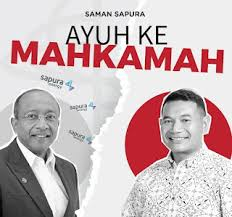
Former Sapura Energy Berhad CEO Shahril Shamsuddin, upset with remarks by Rafizi Ramli, has taken the former Pandan MP to court. Rafizi had issued the statements because he disagreed with Najib Razak’s suggestion on March 21 that the government inject funds to save Sapura Energy. He said he would defend his remarks about Shahril’s remuneration in court, adding that what he had said was to “protect public interest”.

Many Malaysians would welcome the trial so that Sapura’s alleged mismanagement will be put to public scrutiny. They want to know if the alleged excesses of its former CEO and the failure of the board and managers to save the company from near bankruptcy are true. The oil and gas company had achieved an unprecedented rise since its founding in 2012, but by 2015, trouble was brewing.

Attempts to turn the company around were made by corporate board members, who previously worked in other big-name companies like Petronas Carigali and Royal Dutch Shell. They were unsuccessful.

In 2019, Sapura was given a cash injection of RM2.68 billion by Permodalan Nasional Berhad (PNB) in return for a 40% stake in the firm. Why should the rakyat agree to yet another cash injection? Why waste more good money? Despite the continuing resurgence of crude oil prices (after the dip in prices over five years ago), and PNB’s help only three years ago, why is Sapura’s performance still bad?

Najib wants to save Sapura from bankruptcy, but who will help the rakyat if the government has no money? We are aware that the country is heavily in debt. Why should a nation in debt help out rich people and their ailing companies, so they do not go broke?

Many Malaysians are out of jobs, and businesses have been forced to shut down. Many struggle just to put food on the table, with some holding two or three jobs to earn enough. To survive, many have used up their life savings and are now digging deep into their EPF reserves.

With the trial – if it takes place – the rakyat will be able to know how public listed companies are run. They will be able to find out about the wastage, the exorbitant salaries and perks, the poor decision making, the choice of investments, and the losses incurred.

Last year, The Edge reported that speculation was rife that Sapura’s shareholders were furious with Shahril’s remuneration package. His take-home pay was said to be RM84.24 million in 2017 and RM71.92 million in 2018.

In March 2021, Anuar Taib, who has about 30 years’ experience in the oil and gas industry in Sarawak Shell Bhd, was appointed Sapura Energy’s CEO to try and save the company.

One year later, despite the cash injections, the change in members of the board, a new management team, refinancing, and selective bidding for jobs, he warned that the group may have to make tough calls if it is unable to reach workable compromises with its customers to recover or limit losses.

If the government agrees to save Sapura with public funds, the rakyat may wonder why the company should be bailed out yet again. It is not as if it has not been helped before; PNB already gave it a cash injection in 2019. Perhaps the trial – if it takes place – will throw light on what really went wrong. - Mariam Mokhtar

The return of GST – PM Ismail’s Audemars Piguet watch worth RM292,553 can subsidize thousands of chicken...

You know this country is in serious financial trouble when Prime Minister Ismail Sabri floats the crazy idea of restoring GST (Goods and Services Tax) in the middle of global inflation. Either he was extremely desperate because the national coffers are already empty, or he had no idea that Najib Razak’s advice to re-introduce the tax regime is a trick to trap him.
 
If the GST miraculously works, Najib will claim credit. But if it fails, Ismail will take all the blame. You can bet your last dollar that the tax regime will definitely fail again because the previous Barisan Nasional government had already proven that it did not work during its implementation from April 1, 2015 till the new government of Pakatan Harapan abolished it on June 1, 2018.
 
During the 4 years of GST, about RM135 billion (2015 – RM27 billion; 2016 – RM43 billion; 2017 – RM44 billion; 2018 – RM21 billion) had been collected. Yet, prices of goods had continued skyrocketing, despite assurance from a genius like Ahmad Maslan that GST will lower prices based on the argument that SST (Sales and Services Tax) was 10% while GST was only 6%.

On average, Najib government had collected RM4,218 from each of 32 million populations. Assuming the average household size is 4 people per household. It means a whopping RM16,872 were collected from each family over the period of GST. If all the GST collections had been used to help the people, did you ever feel RM16,872 richer from 2015 to 2018?
 
Even if the government had taken half of the RM135 billion to provide subsidies or cash handouts, did you feel the government had helped reduce the cost of living to the tune of RM8,400 (that’s about RM175 extra pocket money every month) during the period of GST? Equally troubling, even the increased tax revenues have not stemmed the growth of Malaysian debt.

Yes, the country’s debt exploded from RM376 billion (2009) to RM1 trillion (2018) during Najib administration, despite the disgraced prime minister’s dubious claims that the GST reform would increase government revenue and make the country’s fiscal condition more independent from vulnerable oil prices. So, where had all the GST revenue disappeared to? One word – leakages.

 
The best part was when the previous Pakatan Harapan government discovered that GST refunds for businesses to the tune of RM19.4 billion went missing from government coffers during former Prime Minister Najib Razak’s tenure. The “missing money” had been quietly moved to the government’s consolidated account instead of the GST refund account.
 
Why did crooked Najib secretly transfer the money elsewhere? That’s because the corrupt and spendthrift government ran out of money, hence the GST refund money was diverted to pay for development and management costs. However, it’s also true that had the Pakatan Harapan not taken over the government, part or the entire RM19.4 billion could be siphoned overseas into Najib families’ pocket.

As a result, GST refunds were not paid for two years because 93% of the money had not been placed into the correct account – showing how easy it would be for PM Najib cum finance minister to plunder the GST revenue. Of the RM19.4 billion meant for refund, RM9.2 billion was from 2018, RM6.8 billion from 2017, RM2.8 billion from 2016 and RM0.6 billion from 2015.

One of the popular arguments presented by the United Malays National Organization (UMNO) politicians and pro-GST fans that the tax regime should be resurrected is because only one out of every 10 Malaysians pay their income taxes. Another argument is that GST must be good because is has been adopted by over 170 countries around the world.

The reason why only one out of every 10 Malaysians pays their income taxes is precisely why Malaysia is not ready for GST – majority of the people are too poor to pay taxes, hence GST will certainly burden them, as proven during 2015-2018. Why countries like Singapore can implement GST, so much so the government had even hiked the rate from 7% to 9% in its Budget 2022?
 
The primary reason is because Singapore is an efficient, competent and a developed country that possessed very strong purchasing power. The purchasing power of Singapore Dollar is three times more than Malaysia Ringgit. Dollar-to-dollar comparison, an iPhone 13 Pro starts from SGD1,649 in Singapore, while the same gadget will cost a leg and an arm – RM4,899 in Malaysia.


Meaning one Singapore Dollar can be stretched much further than equivalent one Malaysian Ringgit. Therefore, even if people from the “little red dot” pay 9% GST, they still can buy more groceries than neighbouring Malaysians who earn the same salary, dollar-to-dollar. More importantly, countries like New Zealand, South Korea and the U.K. lowered personal income tax rates – even removed excise taxes – before implementing GST.
 
Malaysia, on the other hand, is being burdened with not only uncompetitive personal income tax, but also multiple layers of taxes – ranging from excise taxes or import duties, in addition of AP (import permits) to enrich cronies and families of the elite. To make matters worse, “cartels” also exists, so powerful they caused a shortage of chicken crisis, leading to a ban on chicken exports to Singapore.

Najib’s plan when he vigorously promoted GST was to take RM1 from ordinary folks before giving away 10 sen under the pretext of subsidizing and helping people. The tax regime was too complicated for illiterate and gullible people to realize that the corrupt government was actually robbing them. At the end, it was the people who subsidized the government, not the other way round.

Even though part of the GST was used as BR1M (1Malaysia People’s Aid) handouts, the purchasing power of these cash handouts was quickly eroded by rising prices. And there were 7 million households that desperately needed BR1M cash aid, including over 3.7 million households with a monthly income of RM3,000 and below – voters who can easily be bought with cash.

Still, not all rich countries need such tax regime. Hong Kong SAR does not have VAT (Value Added Tax), GST or any other sales tax. Malaysia isn’t the only country that had made a U-turn and scrapped its poorly implemented GST. Countries like Malta, Grenada, Ghana and Belize too had abolished the GST soon after introducing it after the tax regime went wrong.

Now, even Nazir Razak, who was caught helping his crooked brother ex-PM Najib Razak in the 1MDB money laundering, has become a strong promoter of GST. Observe carefully and one can clearly see those elite politicians who strongly wanted the return of the regressive tax regime are actually very wealthy. Do you really think a crook like Najib will feel the pain of paying 6% GST.


Prime Minister Ismail Sabri does not need to worry about paying an extra RM330 (6% GST) for a piece of Burberry shirt costing RM5,500. But the same cannot be said about ordinary folks, who saw how a famous “nasi kandar” restaurant hiked the price of its “roti canai telur” from RM1.80 to RM2.50 (almost 40%) when the GST was implemented in 2015.

So, it’s absolutely false to say the Malaysian version of GST will not burden the poor because essential items will be exempted. Otherwise, how do you explain that basic staple food like roti canai and teh tarik saw huge price increases during GST? Like it or not, the government cannot control the impact of GST because the authorities are simply too incompetent.

When Mr Ismail was published on June 1 saying that the government may re-introduce GST, he was caught wearing an expensive designer watch – Audemars Piguet Royal Oak Offshore Chronograph 44MM Blue Cameo – worth a whopping RM292,553. The watch alone can subsidize hundreds of thousands of chicken – 60 sen per kilogramme for poultry farmers.

The turtle-egg PM whined, groaned and bitched about how the government had lost RM20 billion in annual revenue after the GST was abolished. Yet, at the same time, he has the cheek to show off his RM5,500 Burberry shirt and RM300,000 Audemars Piguet watch, telling the people to be understanding with the financial difficulties faced by the government.

Why doesn’t the government tax the country’s “super rich”, including the prime minister himself, as well as all the former prime ministers, the same way the government had slapped a windfall tax on companies to raise revenue? How could the clueless and incompetent government justify the return of GST, but at the same time, continues wasting money on projects like a new “Shariah compliance commission”?

To convince the public, as a start, the government should stop wasting public money on the super bloated 73 ministers and deputy ministers, 90% of whom are incredibly unproductive and were sleeping on the job. Hong Kong has shown that GST isn’t the only right prescription to raise revenue for a country, especially for a country as toxic as Malaysia.

The right prescription is political reform without the need to suck blood like a vampire from the people, who are struggling to make ends meet. The revenue of RM20 billion can be easily recovered by improving governance, boosting productivity, promoting human capital and eliminating bribes and leakages. Corruption eradication – not GST – is the essential in reducing government financial burden. FT

cheers.

04 June 2022

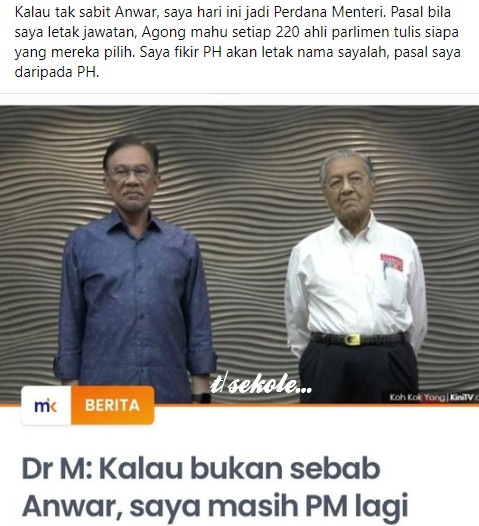
Kalu kapai Kerala tak mendarat sini,atok takkan jadi PM...


PKR secretary-general Saifuddin Nasution Ismail said the issue of party president Anwar Ibrahim not having the majority to become prime minister would not have arisen had Dr Mahathir Mohamad kept his promises. 

He also denied Mahathir’s claim that the nonagenarian would still be prime minister if not for the ‘Anwar move’. The move refers to the Pakatan Harapan leader being granted an audience with the Yang di-Pertuan Agong to prove he had the numbers to form a new government.

“It was not a matter that Anwar had no support. The agreement before the 14th general election (GE14) was that Mahathir would be the seventh prime minister.


“Anwar, PKR, and Harapan kept their promises. Harapan won GE14 and Mahathir became the seventh prime minister.

“He did not agree to set a date to resign but agreed to two years so as not to be seen as a ‘lame duck’. It’s apparent that Mahathir broke his promise,” Saifuddin (above) told Malaysiakini.

He was commenting on Mahathir’s interview with Utusan Malaysia which described Anwar as tidak lurus (not honest). - mk

Suara cam suara Atok...

Tun Dr Mahathir,Malaysian Voters gave you a 2nd Chance to be PM but you screwed it up leaving a bad taste amongst Malaysians.You caved in to the Sheraton Nite betrayal by PPBM,a Party which you founded.You tried using Azmin Ali against DSAI but Azmin turned out to betray you together with Muhyiddin.Despite PPBM having the least MP,you were nominated PM based on Agreement with PH leaders that you should hand-over the PM to DSAI.The Voters have seen throught Tun Mahathir as someone who cannot be trusted and that was the sole reason that Party Pejuang was rejected in Malacca and Johor State Election.Yb Lim Kit Siang has retired from Politic and it is long time overdue that Tun Mahathir follow-suit. - Betul Malu Bukan Maluapa

The old man should blame himself for losing the premiership and accept responsibility for the downfall of PH coalition. From day one of his premiership he was already doing all the political manouverings instead of spending time to govern the nation and carry out the necessary reforms as promised by PH. Without the old man involvement the Sheraton Move could not have happened. The old man's plan went awry and he lost the premiership. When he played with fire he got burnt. Too late to cry over spilled milk. The best thing he can reform himself is to step down from politics and not to mess up Malaysia. He is a big liability to the nation if he continues to be involved with politics. - annonnymous!

Dr Mahathir, don’t cry baby now as you were the one resigned as PM without consulting other parties in PH. You failed miserably at that moment for hoping to be reappointed out of political mess your then Bersatu and PKR traitors orchestrated coup. You were calculating out of no choice the MPs would give in to your version of New Government. The people suffered subsequent Muhyiddin and Ismail Sabri’s administrations because of your overblown ambition at this ripe age. Now, to be realistic , do something good for the wasted trust we had on you. - Hearty Malaysians


Chicken selling price in Malaysia is price controlled. Chicken breeders are making losses because cost of production has increased but selling price of chicken is controlled at RM8.90 per kg. Jadi ekspot ayam ke atau tidak ekspot ayam ke Singapura has no positive effect on domestic chicken supply.Sebaliknya Thailand akan mendapat untung yang lumayan daripada mengganti Malaysia sebagai pengekspot ayam ke Singapura.- Syed Akbar Ali  


So Thailand is going after Malaysia's share of the chicken market in Singapore after Malaysia banned the export of chicken. Look like Bolehland is scoring another own goal... - Sharifuddin Abdul Latiff

cheers.

03 June 2022

Makan kamsen pun lebai dah kenyang...


We are all Rafizis...

I wish to impress that good Malaysians are all behind the idealism, the courage and the will of Rafizi Ramli from the recent PKR win.This article is not about bodekism of a particular personality. Too many academics have indulged in personality bodekism that have won them titles of professorship as well as a cushy post as the PM personal assistant as an ‘expert’.

This article is too send a clear message to two groups of people that we Malaysians are behind the likes of Rafizi, Syed Sadiq, Nurul Izzah, Howard Lee and all the young politicians that will hopefully help usher in a New Malaysia of dignity for all, justice for all, compassion for all and prosperity for all.

Recently, Zahid called for the return of the Original Malaysia because he said the New Malaysia of Pakatan Harapan was a failure. Well, sorry-lah Zahid, my first question is to which Original Malaysia are you referring to? The corrupt Najib-Zahid one or the cleaner Tunku-Tun Razak one? If it was for the latter, I setujulah, but if it was for Bossku or any of that nonsense, well, quoting Tun M, poodah!

Let me illuminate for you Zahid what our New Malaysia that is alongside the ideals of the new crop of politicians spearheaded by Rafizi and company. For the enemies of Rafizi outside or inside of PKR and PH, we the people want to send a clear message that we will not vote in anyone who opposes these new visions.


Firstly, the Original Najib-Zahid Malaysia is full of floods and hunger that have destroyed the Malaysian Dream for many. The New Malaysia will ensure that all families can feed their children by using both the religious and secular financial resources of the country to them.

The New Malaysia will not sponsor million ringgit GLC personalities, will not sponsor huge architectural nonsense for race or religion, will not pay salaries of useless PM assistants or Special Emissaries that violate the Prophet Muhammad’s principle of non-wastefulness, egocentric attitudes or pecah amanah for the poor and the orphans. BN has violated the three sins that the Prophet outlined, and we do not want that Original Malaysia! We Malaysians will vote for hope and idealism, not the party. That must be clear.

In the Original Malaysia of Tunku and Tun Razak,(above) the Masjid Negara was built on the donation of all faiths and good Malaysians. Religion is about compassion, acceptance of others and according dignity to all.

In the Zahid-Najib Original Malaysia, religion was used to threaten others, to steal from Muslim poor and to insult the dignity of all Malaysians under the pretense of ‘moral ugama dan bangsa’. The leadership of BN was steeped in the filth of corruption and sins of creating social and religious unrest under their watch.

Rafizi’s New Malaysia, which we the people support, contains the spirit of Original Malaysia of Tunku and Tun Razak. We the people would also like to give a gentle reminder to Anwar and the Saifuddin group that we will watch very closely if the renewal of hope that Rafizi is bringing is in line with the majority of the PKR leadership.


Any shenanigans on the part of the PKR and PH leadership to hinder, obstruct or side step the new idealism brought in with the recent election, the people will not support those candidates of the Old PKR. This means ‘ANY’ leadership personality.

Malaysians will no longer vote blindly for a party like PKR but will watch carefully the personality that represents the party. We Malaysians will vote for hope and idealism, not the party. That must be clear. In the run-up to the election, we the people will scrutinize every leader, including Anwar.

PKR now no longer stands for the original Reformasi ideals but is filled with opportunist ideals looking to grab political power. Make no mistake, we the people will vote some PKR leaders out if they are not in sync with the new idealism and hope that Rafizi has brought in.

With the Sapura suit against Rafizi, the game of killing political opponents through the police, MACC and the judiciary has begun.

We the people will support Rafizi and his companions with prayers, money and media to send one single message: to sue Rafizi, is to sue ALL Malaysians.

So, I say, bring it on. The more the suit the more the popularity and the wave of sympathy that will overwhelm the enemies of New Malaysia. Ayuh…let’s have the GE15 as soon as possible! - Prof Dr. Mohd Tajuddin Mohd Rasdi

Najib could go to jail, Zahid likely to 
be convicted- PM Ismail just need to 
play dumb and delay election...

Prime Minister Ismail Sabri might be dumb, but some of his advisers are not, especially Azalina Othman. One person equally dumb, perhaps below the PM’s intellectual, is UMNO president Zahid Hamidi. It was a dumb move when Zahid rudely pushed Ismail to give way for a convicted criminal – Najib Razak – to emerge at the centre of the stage in celebrating Johor state election victory.

Even though the United Malays National Organization (UMNO) had won a “landslide”, Ismail was humiliated the moment he walked into the UMNO-led Barisan Nasional coalition’s command centre at the Johor UMNO Liaison Hall. He was greeted with a roaring “Bubar Parlimen!” (Dissolve Parliament) – clearly was staged to pressure the unelected prime minister.
 
True, turtle-egg Ismail Sabri is just one of three vice presidents of UMNO – below Zahid Hamidi in the party’s ranking. This is the first time in UMNO’s history that the party president isn’t the prime minister. Still, as the country’s premier, Sabri should be accorded some respect. After all, it was not the PM’s fault that Zahid is facing 47 corruption charges.

To add salt to the wound, the prime minister was not even invited to give any speech at the Johor victory celebration. Zahid had not only offended and insulted PM Ismail, but told the audience that ex-PM Najib was the big hero, despite the fact that “Tok Mat” Mohamad Hasan (election director) and former Johor Chief Minister Hasni Mohammad had played major roles.
 
When Zahid announced – “This victory is a gift for Bossku” – it was the last straw that broke the camel’s back. The ungrateful Zahid had forgotten how Tok Mat, UMNO deputy president, rejuvenated the party when he was on garden leave. Worse, the popular Hasni was tricked and misled by Najib and Zahid into thinking that he would return as Johor Menteri Besar (chief minister).

Ahead of the Johor state election in March 2022, Mr Najib had met with Johor Crown Prince in February. Hence, it’s hard to believe that Najib had no idea that the chief minister will be someone else, not Hasni. To trick PM Sabri to dissolve the parliament and call for an early national election, Najib and Zahid – UMNO Court Cluster – convinced the party to announce Ismail Sabri as the “poster boy”.

Hasni Mohammad - Johor UMNO

However, if Hasni could be played royally, what is there to stop Najib and Zahid from doing the same to Sabri? As a serial liar, Najib can certainly cook a thousand and one reasons not to make the turtle-egg man prime minister after UMNO wins the next 15th General Election. Once the parliament is dissolved, Ismail Sabri is game over and can be discarded like a piece of soiled underwear.

The only option left for Ismail Sabri to return as prime minister, assuming UMNO could lead its Barisan Nasional coalition to victory, is to go to the poll only after Najib lost his final appeal and sent to prison, or to do so only after Zahid Hamidi is found guilty – preferably both. That’s why Najib went berserk when the lame duck Sabri fought back, refusing to call for an early election.

Yesterday (May 31), in an exclusive interview with Nikkei Asia in Tokyo, the Malaysian prime minister told the Japanese tabloid that he is in no rush to call for a general election anytime soon, arguing that rising food prices and other living costs are reasons the polls have to be considered carefully. Of course, even the hamsters knew it was a delay tactic to buy time.

Unimpressed, Najib immediately attacked the prime minister, arguing that the stakes are too high for Barisan Nasional to delay the national election. The crook who had stolen billions of dollars in the 1MDB scandal lectures the prime minister that inflation have cycles and they last between two and three years. He also said election must be held immediately, while the opposition is in disarray.

Actually, both Ismail Sabri and Najib Razak were lying – there is no inflation. Even if there is inflation, it is extremely low and under control, as declared by Finance Minister Tengku Zafrul and Economic Affairs Minister Mustapa Mohamed. After all, Statistics Department says Malaysia’s Consumer Price Index (CPI) was merely 2.2%, compared to the U.S.’ 8.3% and U.K.’s 9.0%.

Finance Minister Zafrul has also announced that Malaysia’s economy is not only on the right track, but is also growing strongly thanks to the rise in commodity prices namely palm oil and crude oil. Speaking at the World Economic Forum’s annual meeting in Davos, Switzerland, Mr Zafrul told the world that the country could easily splash RM71 billion in subsidies to contain the inflation.
 
Prime Minister Ismail Sabri

Is Najib trying to say the Statistics Department, Finance Minister and Economic Affairs Minister have all lied about the country’s inflation? In truth, Najib panicked as he could lose his final appeal at the Federal Court to overturn his 12-year jail sentence and RM210 million fine after having been found guilty of misappropriating RM42 million in SRC International Sdn Bhd (subsidiary of 1Malaysia Development Bhd).

His strategy to hire Queen’s Counsel Jonathan Laidlaw to argue his appeal at the Federal Court in the coming 10-day hearing (from Aug 15 to 19 and 22 to 26) was a desperate psychological warfare against the judicial system. Najib, who no longer trust his “hotshot” lawyer Shafee Abdullah, hopes a British lawyer could use his English to both impress and intimidate the local judges.
 
If indeed there was a strong case in the first place, even a lawyer as useless as Shafee would have succeeded in overturning Najib’s corruption conviction at the Court of Appeal. It would not have to go to the Federal Court, let alone spending millions to engage a Queen’s Counsel. That’s why Najib went ballistic and gave an order to Zahid to pressure Ismail to dissolve the parliament.

Worse for Najib, his wife – Rosmah Mansor – will know her fate a month earlier when the High Court is scheduled to deliver its ruling on July 7 on whether to acquit or convict the infamous Imelda Marcos of Malaysia. She is facing corruption trial over the role she allegedly had played in securing a RM1.25 billion (US$300 million) project to supply electricity to rural schools in Sarawak.

She was charged with soliciting RM187.5 million (US$45 million) from contractor Jepak Holdings in 2016 and 2017 as kickbacks for securing the Sarawak schools project involving 369 rural schools in the Borneo state. Rosmah initially wanted RM200 million kickbacks (17% of the project value) under the pretext of a “political donation”. The rate was reduced to 15% (RM187.5 million).
 
Interestingly, right after Najib threatened the prime minister, Zahid sprang into action, rallying some 4,000 delegates at its 48th national convention today for the next 15th general election to be held as soon as possible. The UMNO president himself is on the brink of being convicted as his corruption case is quite straight forward.
 
Najib Razak and Zahid Hamidi 

During the trial, Harry Lee Vui Khun, a former director of Ultra Kirana Sdn Bhd (UKSB) told the High Court that his company was paying cash in Singapore Dollars (SGD) on a monthly basis to then-former deputy prime minister Zahid Hamidi from 2014 to 2018 in relation to the Foreign Visa System (VLN) Contract. The corrupt Zahid also received sponsored overseas trip from UKSB.
 
The payments, started with SGD200,000 per month and began in late 2014 was increased to SGD520,000 per month some time in 2017. Zahid had received bribes amounting to SG$13.56 million from UKSB for himself as Home Minister to extend the contract of the company as the operator of OSC service in China and the supply VLN system.
 
Unlike Najib’s popularity derived from “Malu apa bossku” (What’s the shame, my boss?) moniker, Zahid, a Java-immigrant from Ponorogo in East Java, is highly unpopular. A weak leader who is widely known for his arrogance, thuggish behaviour and low intelligence, Zahid has been condemned by even pro-UMNO bloggers, propagandists and cyber troopers.

For example, National Professors Council chairman Professor Dr Shamsul Amri Baharuddin believes Zahid Hamidi should relinquish his post as UMNO president. Likewise, UMNO deputy president Mohamad Hasan issued a warning to Barisan Nasional delegates today that the coalition must evolve in order to address its “toxic” reputation – obviously referring to leaders like Zahid and Najib.
 
Even though Barisan Nasional had won Johor, in terms of votes, it captured only 43.11% of total votes. It managed to win because the opposition was split. Therefore, there’s no guarantee that the coalition could win at the national election because the kingmaker is Borneo states of Sabah and Sarawak, not UMNO alone, which is currently divided into Court Cluster and Minister Cluster factions.
 
More importantly, Ismail Sabri does not see any incentive to call for an early election after how he was treated in Johor. He holds the trump card because only the prime minister can advise Agong (King) to dissolve the parliament. With support from the Opposition, who itself is not ready to face the election; neither Najib nor Zahid can move a no-confidence vote to topple him.

What the prime minister needs to do is just play dumb and drag his feet over the date of the general election. Whether the current inflation is a lame excuse not to go to the polls is debatable. Given the current situation, people would rather see Najib or Zahid in prison first before going to vote for the next government. With both crooks out of the picture, Sabri could easily win UMNO’s top post uncontested.

Sabri’s popularity might skyrocket if Najib or Zahid or both are sent to jail under his watch. Besides, why dissolve the parliament now when he has more than a year left to be in power? A week is a long time in politics, let alone a year. The burning question is whether the turtle-egg man will succumb to UMNO pressure. - FT
 
cheers.

01 June 2022

GST untuk Pak Menteri...


PKR Polls 2022: Not all about Anwar...

After 2 public debates (see here and here), a feisty campaign and a low voter turnout of less than 13% of PKR’s 1.1 million members, the preliminary results from PKR’s party elections results are in.

The main headline — the victory of outspoken, confrontational Rafizi Ramli over the more soft-spoken conciliatory incumbent secretary-general Saifuddin Nasution Ismail for the deputy president position.

Rafizi’s allies secured most of the senior leadership positions, although incumbents holding state leadership positions such as Menteri Besar Amirudin Shari in Selangor and MB Aminuddin Harun in Negeri Sembilan won, as did leaders with strong independent name recognition such as Adam Adli as youth chief.

Despite low turnout among members, PKR’s 2022 polls were largely a victory for democracy. PKR has led the way in bringing about democratic practices in a party election, with a record number of members directly selecting the party leadership. While there have been concerns raised about voting irregularities, PKR has put in place processes to review any problems and dubious voting, and made improvements to strengthen the electoral process. 

The detailed election results will be announced later in the week, but the unofficial results point to significant changes inside PKR. These will, in turn, impact the party’s relationship within Pakatan Harapan (PH) and with voters.


Rise of younger generation leaders

Foremost is the rise of a younger generation of leaders. Over 10,000 candidates contested, with a slew of incumbents losing their positions. Long-standing prominent party stalwarts from Shamsul Iskandar Md Akin of Melaka (Hang Tuah Jaya) to Johari Abdul of Kedah (Sungai Petani) lost to younger challengers. We also see the displacement of incumbents in Hulu Selangor, Sekijang and Batu.

After the Sheraton Move and subsequent party purge of those seen to be tied to the Azmin Ali cartel, PKR’s 7th party election provided an opportunity for renewal. What has emerged is a regeneration; an endorsement of younger leaders that have either stayed loyal to the party’s reformist ideals or strengthened the party through their government positions. 

As is happening across PH parties, those in the middle ranks of the party have now assumed more important leadership positions, as many of those who founded PKR during the height of Reformasi, such as Tian Chua, have been displaced. 

There are now new leaders at the helm who claim their reformist credentials from more recent times (notably, since 2008) and have greater connectivity to Malaysia’s young electorate.


Anwar’s loss

Inevitably, the generational shift affects the standing of older leaders, not least for its party president. Anwar Ibrahim has long been seen to personify the party and its struggle. This is no longer the case. 

In fact, the party polls were arguably an erosion of support for Anwar. While he maintained his hold on the presidency without contest, many of those closest to him, including Saifuddin, Farhash Wafa Salvador Rizal Mubarak (contesting in Gombak) and Johari, lost.

Anwar’s quiet endorsement did not favour those he supported. Quite the opposite. Anwar’s lack of enthusiasm for Rafizi and defensive reactions to his criticisms of the party’s performance backfired. Many who voted for Rafizi were, in fact, voting against Anwar’s record at the leadership helm. There was also open resistance to decisions made by Anwar, as occurred in Alor Gajah where dropped candidate in Melaka state polls, Ginie Lim, won this division.

The party mandate Rafizi has received positions him as an alternative leader to Anwar. The clarion call for Anwar to step aside will become louder as there is now another person to lead the party in the coming 15th general election (GE15).

This will not sit well with the party supremo, who has yet to accept that PKR’s future will be determined by other leaders than himself.


From divided camps to factions

PKR’s party election shows that Anwar has less control of his own party. There is the emergence of diverse, more decentralised power centres. Unlike in the 2018 party polls, where competition among leaders, personality differences and expectations of zero-sum loyalty to the Azmin or Rafizi camps contributed to party splits and conditions that led to the Sheraton Move, the current situation is different. 

Rather than 2 camps, there are now multiple factions, with less strong personality loyalties and greater competition. Men and Malays have won most of the elected positions. One striking development has been an erosion of multi-ethnic and gender representation in the results. Men and Malays have won most of the elected positions.

The voting patterns, nevertheless, reveal considerable variation and complexity in voting.  Of the results posted, they reveal highly competitive contests, with many contests where voting was evenly split.

Many divisional contests came down to a few (less than 20) votes, such as Sik, Subang, Kluang, Kalabakan, Sembrong, Padang Besar, Masjid Tanah, Sri Gading, Segamat, Teluk Intan, Pekan, Parit, Kuala Nerus, Kuala Langat, Kuala Pilih, Kota Bharu, Dungun, Simpang Renggam, Tanjong Manis and Kinabatangan. Many voted for individual candidates in their own right or for smaller clusters of candidates rather than an approved slate of candidates in 2 different camps. This explains, for example, why Rafizi’s allies failed to win all of the vice president or youth chief positions.

While PKR still has divisions, these appear — at least at this stage — to offer greater opportunity for the party to come together and rebuild trust rather than operate in different personality-tied war zones. Crucial will be whether Rafizi adopts a more conciliatory approach towards those he abandoned in 2018 during his respite from politics, and whether Anwar steps away from a long-standing pattern of pitting younger leaders against each other.


Disquiet and trouble

PKR’s internal issues have profoundly affected PH’s political fortunes. The Sheraton Move was tied to divisions inside PKR. As with Umno, PKR’s polls shape Malaysia’s political future. If PKR remains focused internally, this will negatively impact the opposition’s fortunes and its own party’s performance, already at record lows.

The issue of coming together goes beyond PKR, to include how the party’s new leadership will — or will not — work with its opposition allies. Rafizi has had a strained relationship with PH partners in the past and is seen to be resistant to including youth party Muda as part of the opposition moving forward.

It remains to be seen whether those in new leadership positions in PKR have a new vision for the now broader opposition to work collaboratively. Rafizi’s victory brings with it disquiet among other opposition parties, given that his campaign was implicitly critical of PKR’s coalition partners and did not embrace new parties. 

The party, however, that has the most to be concerned about from this result is Umno. The PKR election has energised the opposition, with greater political debate and attention to the need to focus on policies and re-engage the electorate. Umno and former president Najib Razak have been put on the defensive.

Meanwhile, Umno’s leadership remains stagnant and embroiled in court cases, with its party election and the opportunity for younger leaders to rise delayed. Comparatively, PKR’s new leadership is more dynamic and offers younger Malays as leaders to the electorate. This will be especially the case if Anwar finally chooses to step aside and allow younger leaders to move Malaysia forward.

While PKR has a (very) long way to go to recover political ground and will need political allies, the changing of the guard shows that the party is no longer all about Anwar. - Dr Bridget Welsh

Roti canai and teh tarik to cost more from 
June – will be worse if Najib’s GST is still here...

Finding a piece of “roti canai” or a small glass of “teh tarik” at RM1 each, even in the remotest area is extremely difficult, if not impossible. Roti canai – a piece of round plain flat bread – is essentially one of Malaysia’s favourite dishes that is cheap and good for breakfast, lunch and even dinner. Restaurants have either reduced the size or increased the price.
 
But beginning next month, the prices of both food staples will officially become more expensive as restaurant owners are hit with increase prices of ingredients, despite claims by Finance Minister Tengku Zafrul and Economics Minister Mustapa Mohamed last week that inflation or prices of goods are still very low and under control. The government insists the inflation is at merely 2.2%.
 
Some restaurants had already increased the price of roti canai, selling between RM1.20 and RM1.70 a piece. But that could go up again next month to RM2.20 – about 30% increase. A glass of teh tarik could go from RM1.80 to RM2.50 – almost 40% increase. Some operators of mamak restaurants have increased prices of other foods as well, such as “murtabak” by RM1.

Malaysian Muslim Restaurant Entrepreneurs Association said 25 kilograms of wheat flour has gone up from RM45 to RM65. To make matters worse, there is hoarding of wheat flour to raise prices, creating shortages. The price increases and shortages came despite assurance from the Domestic Trade and Consumer Affairs Ministry that India’s wheat export ban would not affect local supply.

But the rising costs of wheat flour isn’t the only factor. The price of margarine has shot to RM100 from RM85, claimed Malaysian Indian Muslim Restaurant Owners Association (Presma). Other ingredients like cooking oil has also gone up – a five-litre bottle which used to cost RM27 is now being sold by suppliers at RM44, a jaw-dropping 63% jump. The story did not end there.

The increase in national monthly minimum wage effective May 1, from RM1,200 to RM1,500 – a whopping 25% – also means hiring has become more expensive, worsen by a shortage of foreign workers. Operational costs such as rentals, which also saw an increase, had forced restaurant operators to take extreme measures such as terminating free WiFi, even closing down their business.

Vote UMNO/BN,GST will be back 100%,
Chief penyamun UMNO dah cakap...

No matter how vigorously you punch the calculator, the food inflation is definitely more than 2.2% claimed by the clueless and incompetent Ismail Sabri government. Now, if you think the current situation is horrible, imagine what will happen if the 6% GST (Goods and Services Tax) introduced during the Najib administration in April 1, 2015 is still effective today.

Of course, PM Ismail Sabri, trumpeted as a humble leader by his hardcore supporters, despite showing off his RM5,500 Burberry designer shirt during a meeting with his Singapore counterpart, hadn’t a clue about the people’s suffering on the ground. Even ex-PM Najib, born with a silver spoon, is still very eager and excited to bring back his pet-project – the GST.

As recent as two weeks ago, during his debate with Opposition Leader Anwar Ibrahim, Mr Najib insisted that the people would be better off now if the Goods and Services Tax (GST) was still around. He claimed GST would have given the country an additional income of RM30 billion, which could be used as an aid for the people during the current trying times.

Najib bragged – “We collect GST when times are good, and when times are tough, we use the money to help people who are in need. For me, we would be better off now if the GST were still around”. He talked as if the GST is the best invention since sliced bread, the magic wand that Fairy Najib could use to give away free cash to the people struggling to put food on the table.

Firstly, if indeed GST is such an amazing magical tool, why didn’t the Perikatan Nasional regime bring back the tax regime since March 2020? Wasn’t Najib one of the lawmakers who had supported Muhyiddin Yassin in toppling the democratically-elected Pakatan Harapan government so that he can become the backdoor PM, the same man who had supported the abolishment of GST?

Yes, Muhyiddin was a strong supporter of Najib’s GST – till his 45-year stint with Barisan Nasional ended in July 2015, when his boss sacked him as deputy prime minister. But when Muhyiddin joined the Opposition to overthrow Najib, he flip-flopped and condemned the consumption tax, only to praise the tax, calling it to be reinstated just days after he became the prime minister in March 2020.

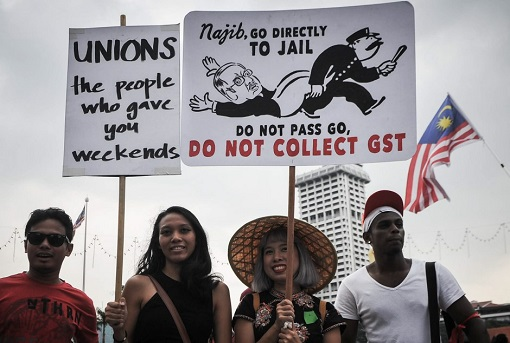
People Protest Najib GST 

The burning question is – why didn’t the powerful and influential Najib push hard enough for the return of GST, the same way he had aggressively pushed for multiple EPF withdrawals, after he succeeded in helping Muhyiddin formed the Malay-Muslim Perikatan Nasional government? Even if both do not see eye-to-eye, Muhyiddin had lost power since August 2021.

Today, the United Malays National Organization (UMNO) is the government. Exactly why hasn’t Najib done anything in the last 9 months to reinstate the GST? Muhyiddin agreed and so did Finance Minister Zafrul, who has hinted that the tax could be re-introduced. Nobody within UMNO, the backbone of Barisan Nasional backdoor government, disagrees over the revival of GST.

Yet, Najib only dares to blow his own horn during the debate – whining and bitching about how Pakatan Harapan abolished the GST and reverted back to the Sales and Services Tax (SST) after it took over the government after the May 2018 General Election. What the heck is he waiting for now- “Malu apa bossku”? (What’s the shame, my boss?)

Secondly, just because essential items such as rice, fish, meat, seafood, milk, eggs, fruits, vegetables, bread and groceries were exempted from the tax regime, it does not mean the food items will not see any price increase. For example, after the GST was implemented in 2015, a famous “nasi kandar” restaurant hiked the price of its “roti canai telur” from RM1.80 to RM2.50 (almost 40%) due to GST.

And the post-GST price increase for roti canai in 2015 happened when the world was super peaceful without Ukraine war or global inflation, mind you. Did you notice that after the GST, the price of almost everything goes up, from roti canai to lobster and from Coke to car. A plate of RM6 fried kuey teow went up to RM7 and a pack of RM5 nasi lemak shot to RM6 – all prices increased by more than 6%.

Does that mean GST is bad and evil? Not at all, but in the hands of the corrupt and incompetent UMNO government, everything becomes toxic. Because of its broad consumption base, people cannot evade or avoid the GST, making it incredibly efficient, so much so that the government earned RM44 billion in revenue in 2017, making it the largest contributor after corporate tax receipts.

Even though Najib and his minions quietly told the gullible Malay village folks that GST was designed to tax the rich ethnic Chinese and reward the poor ethnic Malay, his racist marketing lies did not last long. Every single citizen, regardless of race and religion, was quickly affected by price increases – from baby milk powder to groceries and from fast food to basic entertainment.
 
Only one out of every 10 Malaysians pay their income taxes. Coincidentally, 90% of the income tax is paid by the Chinese in Malaysia, admitted former Prime Minister Mahathir Mohammad. Meaning, since it was implemented from April 2015 to June 2018, the GST collected more taxes from the Malays than the Chinese simply because the ethnic Malay is the majority race, hence the largest consumers.

UMNO and Corruption,Like the bamboo and the river bank...

Thirdly, despite GST is a more efficient tax regime than SST, it failed spectacularly due to government corruption, inefficiency and incompetence. Because it is a tax on the value added at each stage of the production distribution chain, the final price when reaches the consumers were gigantic because at every stage of the distribution chain, the price increase was not 6%, but higher.

So, a product that cost RM1 could cost more than 6% in GST (excluding profits) if each stage of the production distribution chain slapped 10%, 20% or higher tax bracket disguised as profits in anticipation of problems in claiming excess amount for over-paying the GST liability. Worse, it was tedious and troublesome to submit a refund application with the necessary details on the GST portal.
 
They were correct not to trust the government. According to the GST law, a GST refund should be made to the taxpayer within 14 days (for online submission) or 28 days (for manual submission) from the day Customs received the submitted return. However, the Customs can carry out an investigation or audit to validate the GST return – it has a period of 6 years to conduct field audits.
 
After Najib stunningly lost power in 2018, the new government of Pakatan Harapan found that as of May 31, 2018 the outstanding GST refund amount stood at RM19.39 billion. Even some 20 months later in February 2020, about RM7.8 billion of outstanding refunds for the GST have yet to be repaid to taxpayers, causing cash flow of businesses to be negatively impacted.

It was already bad that the GST is a complicated tax to administer, requiring huge amount of paperwork and time. It became worse when the Royal Malaysian Customs Department dragged their feet due to inefficiency. The government agency took their own sweet time to conduct field audits, trying very hard to find faults so that they can demand bribes from business owners before approving refunds.

In July 2021, in the first case of its kind in Malaysia, the High Court allowed a judicial review application to challenge the decision of the customs in rejecting the taxpayer’s application for input tax credit refund (ITC refund). The refund was rejected because the Royal Malaysian Customs argued that it was not made within 120 days from the appointed date, when in fact it could be made within 6 years.
 

The best part was when the Pakatan Harapan government discovered that GST refunds for businesses to the tune of RM19.4 billion went missing from government coffers during former Prime Minister Najib Razak’s tenure. The “missing money” had been quietly moved to the government’s consolidated account instead of the GST refund account.

Why did crooked Najib transfer the money away? That’s because the corrupt and spendthrift government ran out of money, hence the GST refund money was diverted to pay for development and management costs. While Najib insisted no money was stolen, the fact remained that the money did not belong to the government to be spent as and when the PM likes.

As a result, GST refunds were not paid for two years because 93% of the money had not been placed into the correct account. In a letter dated October 9, 2018 to the Public Accounts Committee (PAC), then-Attorney General Tommy Thomas said it was a breach of fundamental trust law principles and trust accounting requirements, and that “criminal liability must be further considered.”

One could only imagine what will happen to the diverted RM19.4 billion had the corrupt Najib administration not defeated in 2018. Most likely, the money will be permanently missing. Delayed refunds will result in a negative impact to cash flow, leading to an increase in the cost of doing business. That explains why price increases were many times more than the 6% GST.

Generally, businesses will pass down any taxes to consumers, and in the process raise prices. Additionally, any extra cost of compliance to new laws such as the GST will also be parked under consumers. Therefore, if GST still exists today, roti canai and teh tarik will definitely be more costly. It’s true that GST can help curb leakages and tax fraud.

But in the case of Najib and UMNO, it was the government who committed leakages and fraud. The biggest problem is that the irresponsible government tends to steal and plunder when faced with a sudden flush of money. Sri Lanka is an example of countries struggling with poorly conceived and implemented GST regimes. And we know what happens to Sri Lanka today. - FT

cheers.